How to Teach the Concept of Blue Aba
I of the "missions" I have in designing educational programs for any student is to find ways to practice skills so that information technology is fun and engaging while promoting generalization. This means that nosotros need lots of different materials and different types of materials for each skill we teach. Generalization is what it's all about. If the learner tin't apply the skill in a variety of places for different purposes, our instruction hasn't been effective. Or as I like to sum it up:
[socialpug_tweet tweet="Life is not discrete trials. #ABA #naturalisticinstruction" display_tweet="Life is not detached trials."]
Discrete trials are the way we oft start teaching a skill and then that we can control the way information technology'due south presented, specially to learners who are likely to attend to the incorrect element of education. However, equally the learner masters skills in DTT we need to think about how he is going to practise the skill in the existent globe. So, for each of my discrete trial kits (or at least most of them) I will be designing generalization materials to get along with them. I try to make the generalization materials set up up with dissimilar levels of difficulty so that the learners can use them even when they are mastering later parts of the discrete trial programs.
These aren't materials that I would use for discrete trials because there are too many things that might misfile the learner's understanding of the true concept. For example, if he was doing a file binder activity, by default all the pieces volition lucifer something so you lot can't exist certain he hasn't learned to exit the one he doesn't know until last then put it in the remaining spot. Nonetheless, these strategies will assistance to reinforce the skills and generalize them to new materials while also working on other skills like following directions and literacy (finding a book title, reading front to back, etc.).
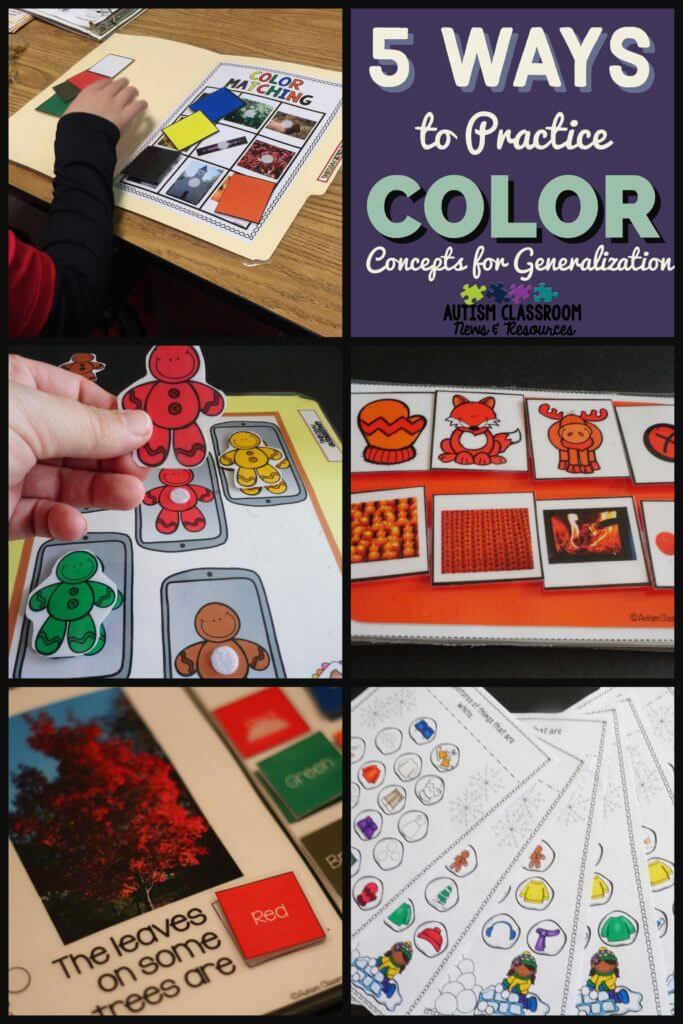
1. Scavenger Hunts / I Spy
Scavenger hunts are 1 of my favorite ways to move learning around the room and become a student physically also equally mentally engaged in learning. These tin can actually start with the same cards you used in discrete trials. You can hide the cards around the room and take him find them. Then, yous tin outset to branch out and use other cards or have him look for items that are the right color. For instance, I say, "I spy something reddish in the kitchen" and the learner has to go detect the reddish mixer. This is an activity that could have a set list of colors to find (find 2 red things and 2 blue things) or information technology could be a more than breezy game of I Spy while you are waiting for the bus. These are a groovy way to exercise receptive ID of colors if the learner responds to your 'I spy" or finds thing on a chase. Y'all can use them for matching by giving him an object of the same color and tell him to find one that matches. And yous can practice expressive ID of colors by having him tell you what color something is that yous see (or he sees).
 ii. Interactive Books
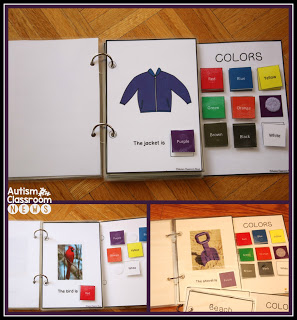
I love interactive books. Love them! You can fold so many different concepts into them; yous can include manipulatives with them so the student participates. They promote literacy. They are likewise a great mode to bring generalization of the DTT concepts into grouping activities (by reading a volume at story time or morn coming together).
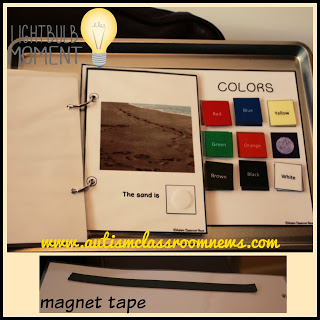 These books are a fix in my Summer Color Activities for Generalization. The student has to find the color square that matches the color of the movie. Each set has a clip art version and a real photograph version and, for summer, they center around beach and camp themes. These are a mode for the students to practice matching the colors to the colour of real items. It'southward important to recognize that these types of books will practice matching colors with new materials if the learner uses them on his / her own. If yous read it with him, you can create opportunities to name the color (expressive ID) past asking, "What color is the jacket?" You lot could cover up the picture show and tell him to "Find imperial" on the cards before matching to work on receptive ID.
Every bit an bated, I realized when making materials that I struggle with property out the books and matching cards, especially in a group, when the volume is soft cover and ofttimes not bound. I've used foam board earlier to mount the volume on and talked well-nigh that Hither, but I realized that the $1 cookie sail I was using would be a smaller solution and fit the book perfectly. Just put a strip of magnet record on the back of the volume and you lot tin put it on the cookie sheet, hold it out for the students to choose a matching color, and it volition stay stable.
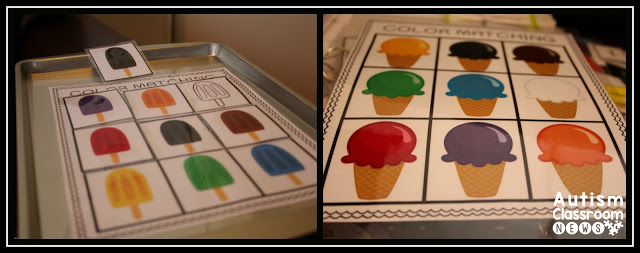
3. File Folders, Clothespin Cards, and Cookie Sheet Activities
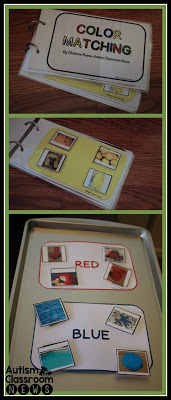
File folders and cookie sheet activities are another bang-up mode to exercise color skills. The ones above do unproblematic matching skills of the same detail of the same color to its match. You could use just one sheet to talk about the colors for expressive and receptive ID or put them in independent piece of work for the students to practice their matching skills. These are skillful materials for early on practice in learning colors.
The examples to the right tin can be used in a diversity of ways. These are real photos that can exist matched to a colored page, a colored part of a page in a file folder or on a cookie sheet, or made into a sorting adaptive book. Generally, if making them into a file folder or sorting book, I would utilize strips of Velcro (I ran out of that when I fabricated these) so that you avoid giving a cue to the student about how many pictures will keep each color. I created them with solid colour spaces (like the ane in the center) and more printer friendly ones that are only outlined with the colour written in the aforementioned color that is matched.
Clothespin cards are another great way to practice colors using these same principles. Put the pictures on clothespins and have the students clip them on to the colored pages.
iv. Circling the Identified Color
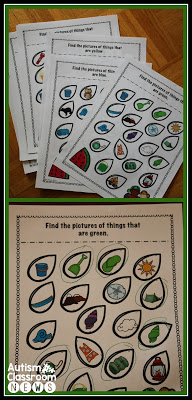
For almost students learning colors, this is an activeness that will need to be completed with an adult nearby. However, it would be a great kind of activity to give a student while you are working individually with a nearby pupil. This would allow you to tell him to find and circle all the greenish pictures and and so turn and exercise some trials with the 2nd educatee. Again these are all designed for summertime with camp and beach themes to the items and I made one for each of the nine colors. You can also use them as a find and cover with poker chips or bingo chips. Considering they focus on colors you lot will need to print them in color but you tin put them in page protectors and use dry out erase markers to easily reuse them.
5. Coloring past Direction
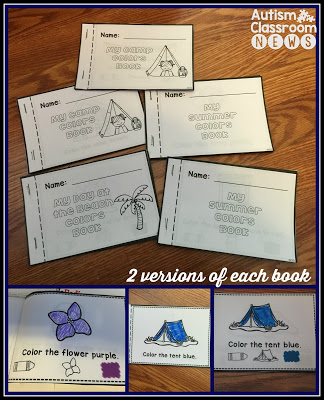
Having a student color something according to directions are another neat way for them to practice using colors in a functional mode. These mini-books are set upward so that you can photocopy them and have the students cut them out and assemble them. And so you can read the direction of what to color each particular (due east.g., color the blossom imperial). I fabricated one fix without colour and motion picture cues so that you tin can read them to the student to requite the direction verbally (receptive ID) and an identical set that has picture directions so that students can follow them and complete them independently (matching colors). This blazon of matching, though, takes an extra stride of having to detect the right color crayon based on the direction and colour the item, then it gets him started having to find items that are the right color for the job.
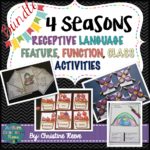
So, there are certainly a ton of ways to work on generalizing colour skills into the "real world" from talking about colors as you pick flowers to pointing them out in story books. If y'all are interested in checking out these generalization activities for all seasons, click on the picture show beneath to find them in my store. Yous tin can as well find similar generalization materials addressing receptive vocabulary skills focusing on identifying items by features (characteristics or adjectives), function (what we employ it for) and categories.
 How exercise you generalize colour skills in your classroom?

Source: https://autismclassroomresources.com/5-ways-to-practice-applying-color/
0 Response to "How to Teach the Concept of Blue Aba"
Post a Comment